Wednesday, December 29, 2010

"My biggest crime is that I'm Japanese"


As part of my research for my thesis I watched a Japanese trilogy called The Human Condition (人間の条件), which was a Japanese movie set against the Japanese occupation of Manchuria. Although the movie was melodramatic, one line stayed with me which was (roughly remembered):

It seems my biggest sin in something I can't be blamed for, being Japanese


The hero Kaji (梶) tries and fails to implement a more humane form of colonialism. It's failure is that the very structure of colonialism and its presumptions are inhumane. In Brian Friel's The Home Place the "anthropological" projects that were going on represent the guise of something that looks innocent enough but is actually equally part of the colonial machine. That Christopher allows these projects to be carried out angered me, but when Con interrupts Richard's experiment by threatening the harmless and benevolent Christopher, some of the anger was replaced with pity, This made me think of the usual response to the descendents of Planters in Northern Ireland and its usual association with the Israeli occupation of Palestine (in Northern Ireland this can be observed by the Israeli and Palestinian flags flying alongside the tricolour and the Union Jack on telegraph poles and wall murals throughout the North.)


But to go back to the point I raised from The Human Condition we come to the question of responsibility, blame and inheritance. All the planters who made a conciouss choice to take part (for whatever reason) in the colonial project in Northern Ireland are now long dead. The rest were born into a status quo. There is, in essence, a difference between maintaining the colonial system you were born into and making a choice to partake in a colonial project - and so there is a difference between the descendents of Protestant (English/Scottish) planters in Northern Ireland and the first generation colonialists who are pushing into the Gaza Strip for more territory. Can one then blame someone for being born? One can say that this person once born can choose to fight the colonial machinery, but this is fighting to annhilate himself. The problem with blame in postcolonialism is the ephermeral nature of human life.

The Irish characters in the play are sympathetic to this situation, they take exception only to Richard Gore's measuring of the head sizes of "natives" but respect that Christopher was a good landlord and a generous man - even if born into a colonial household. This does not stop him feeling a traitor to "his kind".

The conclusion Friel draws is unclear. The threat of violence in the play seems almost a superegoic voice of history, enunciating the crimes of the Gores's forefathers. But how long can one hold on to past wrongdoings, when does a colonized settlement or territory become just a "home"?

"It will not ripen well"


I started this book, Parrot and Olivier in America by Peter Carey, expecting something similar to Don Quixote and an antiquated redo of servant master relations. The book was, however, hilarious, it demolished the American Dream and American romantic notions of their own history with tender satire.

The tale is a fleshing out and reimagination of the travels of Alexis de Toqueville, a noble from an old Norman aristocratic family who wrote Democracy in America after his travels there in 1831.

His book not only brings to life the attitudes and society one can imagine in the era just after the French Revolution and the United States Declaration of Independence, but it also encapsulates the essence of French, US, and British character which shape the way the countries have evolved.

At university I was friends with an Etonian and another guy from a public school who constantly extolled the virtues of an aristocracy (or from the more politically correct of the two, the need for a leading class and a Conservative government). This was material for much debate as I was repulsed by the presumption of these two Englishmen, who claimed some sort of superiority for no really credible reasons (one a birthright the other money). The arguments circulated around the common people not really knowing what was good for them etc. This is the voice in the book that Olivier represents, who demand a life of leisure which requires others to work their hands to the bone. The only qualification is to keep them pacified enough to prevent revolution, which the French had overlooked in their overindulgence. The book however, while satirizing the Garmonts, is even more cynical of the "democratic spirit" of the New World, which essentially reduces equality to a monetary concept, or as it is put in the book:

Equality exists only in the marketplace


The other character in the novel, Parrot, Olivier's English servant, originally the more cynical of the two, in the end holds out hope for America and is entranced by the American Dream. However, the nature of American democracy was he states essentially a nominally distinct version of monarchy:

Democracies and monarchies, it does not matter - the world is filled with poor men tortured by the state. The rich man makes an endless supply of them, and when the Americans won their independence the king must find a new place to put his prisoners. So - Australia was invented by the British, that whole dry carcass, its withered dugs offered to our criminal lips.


The naivete of Garmont in his mission comes to a cynical end when his relationship with an American girl and America itself comes to and end:

'Yes, and you will follow fur traders and woodsmen as your presidents, and they will be as barbarians at the head of armies, ignorant of science and geography, the leaders of a mob daily educated by a perfidious press which will make them so confident and ignorant that the only books on their shelves will be instruction manuals, the only theatre gaudy spectacles, the painting made to please that vulgar class of bankers, men of no moral character, half-bourgeios and half-criminal, who will affect the tastes of an aristocracy but will compete with each like wrestlers at a fair, wishing only to pay the highest price for the most fashionable artist.


This made me think of the way that we conceive of politicians in general, and particularly the way the American president is perceived. There seems to be an effort to elect an every day person as a president or there seems to be some joy taken in the idea that anyone could become the president in a democracy. Is this then a good thing? And in a century were there is no moral impediment on people (the multitude of churches are all subordinate to the state in most countries) only a legal impediment. So in effect if it's legal then it's ok. This leads one to question the awe or leadership of the president or other politicians if there is no hierarchy in society. By electing people that are average or ordinary there seems little value in their leadership. As is stated in the book:

All official positions are given for political reasons; the spirits of faction and intrigue grow here as they do under monarchies


That money is the deciding factor over justice, and that this is acknowledged by the Americans themselves is something distasteful to the French noble:

It was an event impossible to conceive in France, for I obtained this justice - and justice it was - with the ditribution of dollars [...] you would think this such a truly disgusting matter that it needs be transacted in the dead of night, but no. The beneficiaries had come straight from their homes or counting houses, the otherwise elegant Mr Peek carrying a small dot of egg yolk on his dimpled chin.


I think what Olivier criticises here is the openess of the role of money in securing justice. If the French were unfair in their treatment of prisoners, it was under the understanding that they were "guilty" even if this a pretence. But in American society this facade of justice and right and wrong even is subordinate to the rule of money. So for all the promise of democracy, its virtues were also victim to what Olivier calls:

this national manner of joking, where the main point, by dint of boastfulness and exaggeration, was to make the visitor appear a fool


I thought this was interesting when you look at the recent controversies on torture and Guantanemo Bay in the US. These are discussed in terms of legality, but not so much in terms of morality, because morality perhaps isn't seen as having a role in government in the US when it comes to security issues.

I'd be interested in what the two of you think, given that you're both Americans even if you haven't read the book.

Definitely worth reading 5/5

Tuesday, November 16, 2010

Into Thin Air by Jon Krakauer

I just finished this intense personal account of the 1996 Mt. Everest disaster.  More than half of the book is primarily exposition and background information on the sport of mountaineering and on the individuals involved.  Then once they've reached 8,000 meters (approx. 26,000 ft) and things start getting dicey with the oncoming gale, the books starts getting seriously tense and I couldn't put it down.  While, the book is engrossing and truly an important warning for any inexperienced climber harboring romantic notions of reaching the roof of the world, this should serve as a sobering realization that Mt. Everest (Sagarmatha) is no small feat that relies not merely on technical skill and experience but also interminable will, self-discipline (to turn back around at the agreed-upon time even within a stone's throw of the summit), timing, and sheer luck.


I'm very grateful that Krakauer summoned the courage and resolve to write this harrowing personal account of the tragedy, but at the same time I can't help but agree with some of the criticism by the relatives of the deceased.  At many times throughout the tale, Krakauer seemed to heavily criticize certain individuals or even groups of people who he felt directly contributed to the disaster.  As I wasn't there I cannot judge the veracity of these allegations but they just rub me the wrong way.

Scott Fischer's sister, Lisa Fischer-Luckenback wrote:


What I am reading is YOUR OWN ego frantically struggling to make sense out of what happened.  NO amount of your analyzing, criticizing, judging, or hypothesizing will bring the peace you are looking for.  There are no answers.  No one is at fault.  No one is to blame.  Everyone was doing their best at the given time under the given circumstances.


No one intended harm for one another.  No one wanted to die.

What did shock me was how he described how callous some individuals were.  For instance, the Japanese team who apparently saw the dying Ladakhis on the trail coming up from the Tibetan side of the mountain and merely ignored them without offering any assistance whatsoever.  Then when interviewed about it, their (Hanada and Shigekawa) only response was, "We didn't know them.  No, we didn't give them any water.  We didn't talk to them.  They had severe high-altitude sickness.  They looked as if they were dangerous."

"Shigekawa explained, 'We were too tired to help.  Above 8,000 meters is not a place where people can afford morality.'  Turning their back on Smanla and Morup, the Japanese team resumed their ascent, passed the prayer flags and pitons left by the Ladakhis at 28,550 feet, and—in an astonishing display of tenacity— reached the summit at 11:45 A.M. in a screaming gale."

This passage made me take pause and I had to put down the book for a minute and get something to drink since I could not comprehend putting the dubious goal of reaching the summit over helping fellow human beings on the brink of death.

Having lived for a period of time in Taiwan myself it was also disheartening to hear of the poor actions and behaviors of the Taiwanese team, which was apparently universally panned and derided by the other groups.  First for their incompetence in mountaineering and for their debacle on Mt. McKinley in Alaska where they placed the lives of others in danger.  Then, this time on Mt. Everest, when one of their Taiwanese team members fell to his death while trying to evacuate his bowels, the team leader, 'Makalu' Gau, just replied, "O.K." on the radio and continued to make his ascent to the summit. (He explains his questionable actions and attitude in "Frontline:  Storm Over Everest," but I'm wondering if this was just rationalization ex post facto.)

Of course, this book isn't entirely a chronicle about the foibles and frailties of man, but also about the triumph and heroism of common people.  Stuart Hutchinson and Neal Beidelman stepped up when others collapsed due to hypoxia, hypothermia, severe altitude sickness (HAPE, HACE, etc.) and/or severe fatigue.  Also, Rob Hall died almost entirely due to the responsibility he felt as leader of the expedition.  He stayed up on the summit because Hansen could not budge without bottled oxygen.  He could have easily left him and gone down to base camp but heroically and obdurately, he refused to leave him and as a result died due to exposure.

I think this message from a Sherpa hits the message home:


I am a Sherpa orphan.  My father was killed in the Khumbu Icefall while load-ferrying for an expedition in the late sixties.  My mother died just below Pheriche when her heart gave out under the weight of the load she was carrying for another expedition in 1970.  Three of my siblings died from various causes, my sister and I were sent to foster homes in Europe and the U.S.


I never have gone back to my homeland because I feel it is cursed.  My ancestors arrived in the Solo-Khumbu region fleeing from persecution in the lowlands.  There they found sanctuary in the shadow of "Sagarmathaji," "mother goddess of the earth."  In return they were expected to protect that goddesses' sanctuary from outsiders.


But my people went the other way.  They helped outsiders find their way into the sanctuary and violate every limb of her body by standing on top of her, crowing in victory, and dirtying and polluting her bosom.  Some of them have had to sacrifice themselves, others escaped through the skin of their teeth, or offered other lives in lieu. . . .


So I believe that even the Sherpas are to blame for the tragedy of 1996 on "Sagarmatha."  I have no regrets of not going back, for I know the people of the area are doomed, and so are those rich, arrogant outsiders who feel they can conquer the world.  Remember the Titanic.  Even the unsinkable sank, and what are foolish mortals like Weather, Pittman, Fischer, Lopsang, Tenzing, Messner, Bonington in the face of the "Mother Goddess."  As such I have vowed never to return home and be part of that sacrilege.

I'm not sure if sacrilegious hubris is what truly angered Sagarmatha and caused her to wreck revenge on her hapless victims but ever since the British first decided to conquer the world's tallest mountain, she has claimed 200 lives and a 120 of those lifeless remains are still frozen on her slopes.


(For those interested, you can read the original Outside magazine article that Jon Krakauer authored here.)

Sunday, November 14, 2010

Овсянки / Silent Souls (2010)


This is a Russian film by director Aleksei Fedorchenko (Алексей Федорченко) which was shown on the 14th November 2010 as part of the Golden Horse Film Festival (金馬影展) held in Taipei annually. The film lends itself to comparison with a recent Taiwanese film which is also being shown at the festival Seven Days in Heaven (父後七日). Both films deal with the grieving process, although the way it is dealt with is and its cultural significance differ greatly. Silent Souls deals not only with the death of Tanya and the protagonist's father, mother and sister, but also with the death of the Meryan culture, which the protagonist sees as a necessary evil, that should be let be. Although the Finno-Ugric Meryan language had been lost, some of the traditions, like tying coloured threads onto the pubic hair of new brides and dead women and "smoking" i.e. telling someone else all about the intimacy secrets between you and your lover before their body is cremated, had been preserved by some. The protagonist had collected these cultural remnants, along with photographing the typical Meryan features, but he knows that with his death the only traces of the Meryan way of life will drift into oblivion. The Meryan customs bring comfort to the man whose wife has passed and to the protagonist when his father passes. Seven Days in Heaven, in contrast, although it also shows the traditional funeral rites, uncovers with gentle humour the artifice of these rites and how distant they hold one from the real emotions of grief. The two films on the surface seem then to work to opposite ends, the former is a melancholy eulogy for the great Meryan cultural tradition in anticipation of the imminent extinction of its memory, while the latter is a tender but satirical look at the traditional culture of Taiwanese.

With similar yearning for the past to the protagonist of this film, the notion of Irish Nationalism, which invents for itself a pre-colonial conception of Ireland which a United Ireland could hypothetically inherit, it insists that Irish cultural traditions should be resurrected, and Irish language and culture should be imposed in what is now called Northern Ireland, which would be incorporated into the Republic of Ireland. It is likely however that it was Ireland's colonizers that endowed a collective identity upon the Irish, whose concept of the world I doubt fitted into the modern concept of nations or indeed "the Irish". This in my opinion would change the nature of those traditions, reinventing them into autocratic conventions that mimic the very cultural hegemony that erradicated them in the first place. The protagonist's resigned entreaty from beyond the grave is to "let it be", to let the cultural traditions that he so painstakingly researched fall into irrelevance is moving and reminiscent of the words of Hugh in Brian Friel's Translations:

"a civilization can be imprisoned in a linguistic contour which no longer matches the landscape of ... fact. [...] We must learn those new names. [...] We must learn where we live. We must learn to make them our new home. [...] It is not the literal past, the 'facts' of history, that shape us, but images of the past embodied in language. [...] We must never cease renewing those images, because once we do, we fossilize."1
This then is the element that unites the two films, the necessary evolution and dissolution of cultural rites with the passing of time. Nothing can be forcibly retained in the cultural
mêlée, retaining anything by force will change its nature.

The film is beautifully shot, and the emotions behind the stolid 'expressionless' faces are intriguingly moving. There is no doubt that the film is open to a variety of interpretations and at times, given my unfamiliarity with Russia, some of the jokes were lost on me, however, there was a remarkable anti-dramatic quality to the film, with the unresolved love triangle, the raging passion of grief and the death of a culture all faced with a melancholy abandon, and acknowledged dispassionately by the characters themselves. The activity of the birds in the film could be taken as a proxy for the human emotion, when the men are silent the birds call excitedly, and just before the violent crash that concludes the film, the birds become silent.

Film Rating:
5/5
Slow moving but beautiful for that

Watch the trailer here


Saturday, November 13, 2010

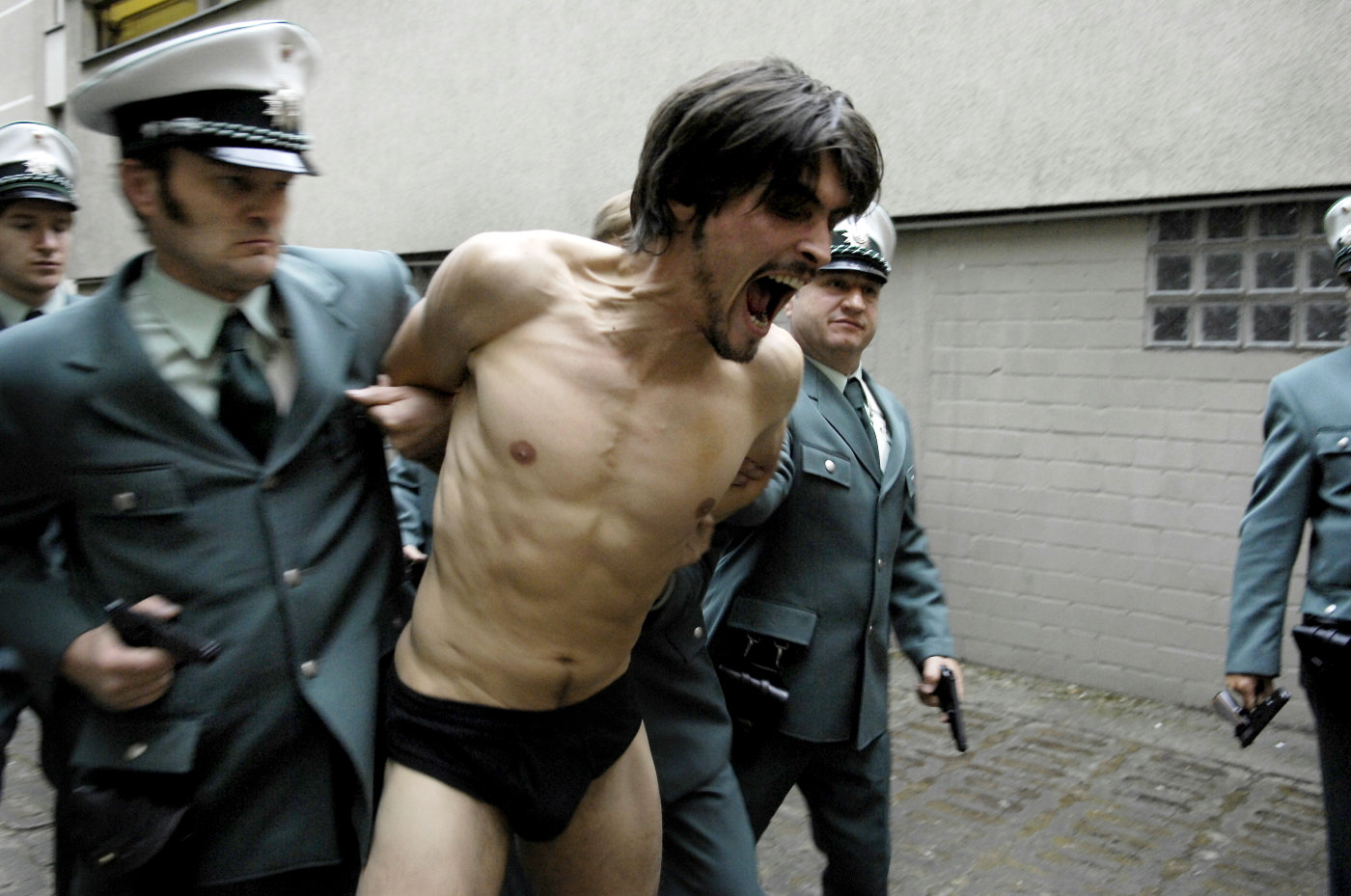
Der Baader Meinhoff Komplex (2008)


This German film, directed by Uli Edel and written by Bernd Eichinger (the same guy who wrote "Das Parfum" and "Der Untergang"),  gives my generation a glimpse into 1970s Germany, where the social and cultural revolution was even more intensified than in the U.S. as the youth of Germany felt a personal responsibility to prevent fascism to rise again.  At the time, the university students in Germany felt American imperialism was encroaching around the world and they felt compelled to prevent another Hitler from assuming power.  One of the protestors, shirtless and brazen, shouted, "Dresden! Hiroshima! VIETNAM!"  I believe this summed up their anger and frustration at the American military response to the 'red terror.'  (In an earlier scene, Gudrun passionately decried America's involvement in the escalation of the Middle East conflict by supplying Israel with fighter jets and munitions.)


The film later focuses primarily on a radical faction of the disaffected youth — the Red Army Faction (RAF).  This group grows increasingly violent as they find peaceful civil disobedience to be ineffective for immediate change.  Their protests and minor crimes for attention soon escalate into organized bombings, robberies, kidnappings, and assassinations.  This film lets you get in the shoes of the terrorists and show what was the impetus for this movement in the first place.


One of the arsonists, Gudrun Ensslin, was interviewed while in custody and she told the journalist:  "This time we will put up resistance.  We have a historical responsibility.  People here and in America eat, eat, and shop, so they can never reflect or gain awareness, because otherwise they would have to do something. [...]  I'll never resign myself to doing nothing.  Never.  If they shoot our people... then we are going to shoot back. [...]  All over the world armed comrades are fighting.  We must show our solidarity. [...]  Such sacrifices have to be made.  Or do you think that your theoretical masturbation will change anything?"


"What we need is a new morality.  You have to draw a clear line between yourself and your enemies.  Free yourself from the system and burn all bridges behind you."
-Gudrun

Trailer (in Deutsche because the English trailers don't do the movie any justice):


The movie starts off great with a string of interesting characters, great cinematography, and a gripping storyline.  While the acting is superb by all the major actors and actresses, the film tends to drag a bit after the exposition.  Also, the denouement also seems to be sloppy when compared to the rising action.  The ending also seemed abrupt and unfinished; an epilogue might have helped with closure.  Overall though, I thought the film was great and it stirred up great interest in me concerning the RAF, which I've never heard of before.

I also never knew about the disturbing fact that denazification was not complete in Germany in that many ex-Nazis assumed positions of power in Germany after the war.  (source:  Wikipedia — Red Army Faction).

Monday, November 1, 2010

A Whispered Life (2010) Marie-Francine Le Jalu, Gilles Sionnet


This film dealt with superfans of Japanese writer Osamu Dazai (太宰治). At first sight, given that the focus of obsession for these fans is an author and his novels, these fans might seem to transcend our expectations of the vulgarity of worshipping popstars, or cultural icons, it is soon clear, however, that this is not the case. The fans' obsession differs little from the teenage girls who scream hysterically at boybands. Throughout the course of the documentary the fans consistently glorify suicide and death, all the characters in the film were slightly repugnant in this way. Suicide in the film was ironically portrayed as another way to become eternal, similar in a way to the very egotistical act of writing or to the very concept of American Idol. The dramatic pathos of suicide is an attempt to endow their empty lives with meaning; an attempt to supercede the boundaries of life and death. I remember one of my teachers telling us about a Chinese poet who tried to launch his fame by commiting suicide after the completion of his book, in an attempt to mimic the suicide of other literary greats in Chinese literary history, like Qu Yuan (屈原) and Lao She (老舍). His plan failed because his writing was so bad, so he garnered attention by his suicide but his work was quickly forgotten. Each of the characters implied that "they were writing" and are attracted by suicide and mental illness as a way of marking their imaginary genius. This marks their lives with melancholy and depression, which they suppose to be central to the creative project when it in fact is seemingly incidental to creativity. The character in the film who writes her blog believes herself to be writing something of great value, and ties this value to depression and suicide, but what she is writing is the mundane description of common depression. The film echoed Dazai's call for "Love and Revolution", the directors went on to explain that they had interest in Dazai for the French qualities of this very call. This call rang false for me though, as this urge to mark one's life in the taking of it, is in essence a strong statement of one's belief in the world; one has to believe in something to be subsequently disappointed in it. Every one of the fans seemed to me to be no different from those desperately untalented people who attend American Idol auditions with so much self-belief, only to realize that talent is not a state of mind. The message that the documentary communicated to me, was similar to that of shows like American Idol; to embrace the ephermeral nature of life, and renounce attempts to hold onto this world beyond the bounds of death and to live averagely.

Film Rating 4/5

Thursday, October 28, 2010

Gallants 打擂台 (2010)


I thought this was a great movie. I watched a couple of weeks ago (sorry for the late post), and the core theme of this movie is nostalgia. At its base, it is a traditional Kung-fu movie, but I think its really about Hong Kong people feeling lost and disconnected in the new age of technology and globalization of culture, and yearning for the old life style in Hong Kong, which is reflected by Kung-fu and the small villages around the edges of Hong Kong.

The movie starts out with Cheung, a dweeby guy that works for a real estate agency and is pretty unsuccesful, but Cheung is kind of a dick because, even though he is a skinny guy, he used to beat on his neighbor. So, his boss sends him to some tiny village in Hong Kong because they want to smash everything and construct high-rise apartment buildings. Being a dick, Cheung starts picking on some fat kid, but the kid's brother comes and scares him off, and then Cheung is saved by Dragon (or Tiger? I forget whose name is what), one of two aging kung-fu students who have dutifully waited by their master who has been in a coma for thirty years. Then, Cheung meets up with the neighbor kid he used to beat up because he is supposed to help them take over the village to build the apartments.

Anyway, I would not say its a "deep" movie, but there are definitely a lot of nostalgic elements flying around, and its a fun and entertaining movie.
Rating: 4/5