SPOILER ALERT
The end of Breaking Bad, I have to say, was actually a pretty disappointing end to a brilliant series, as I felt it didn't add anything that we hadn't already seen.
What had engaged me about the series was the premise of what makes a good man bad and inversely what makes a bad man good. Walter White was a family man and at the start of the series he seems goofy but essentially kind-hearted. Jessie, on the other hand, is a drug addict and a high school drop-out who picks on the vulnerable. As the series progresses we this change with Walter becoming increasingly "evil" and Jessie becoming the one who seems most under the burden of conscience.
At first it is the healthcare system that the show seems to target for criticism - a proud man who is trying to support his family is driven to illegal activity by escalating healthcare costs after being diagnosed with cancer. This, however, does not suffice in explaining Breaking Bad. We see through the fallacy of the good man driven to crime simply by a flawed medical system at certain key moments as the plot develops. One of these moments is when Walter lets Jane overdose when he could have saved her life to protect himself from blackmail. This is when we get an insight into Walter's "family-first", self-protectionist ideology, the guiding logic of which is that the suffering of others is secondary to the interests of him and his family - what falls under these interests develops throughout the show from being simply survival in the face of cancer at the start to inexhaustible wealth and power at the end of the series.We see him develop into a Napoleonic figure unwilling to relinquish any power, but still able to justify his encroachment in terms of a protectionist ideology - in part his victimhood (cancer) empowers this ideology, in that the random bad luck and unfairness that is involved in getting cancer undermines the American Dream and allows him to shift this bad luck onto other "hapless" victims that result from his activity.
The series has echoes of Dogville, in which the impoverished and hard-working residents of a town, who at first seem like honest, hard-working people, are slowly revealed to be cruel oppressors when given any power at all over another person, which they each rationalize in their own way.
I found it hard to work out if Walter White was an everyman and if he was a figure that we were all capable of becoming when left with little to lose or if he was meant to be an essentially amoral psychopath who had just been subjugated to social norms before his diagnosis, eager to mean something before he dies, revealing what exactly is most important in the way he strives to see himself.
The latter seems more likely when we compare Walter and Hank or even Walter and Jessie. Hank sticks to a "moral" path throughout the whole show, playing almost an alternate Walter when his whole career goes up in smoke and he is paralyzed from the waist down. He's, by no means, perfect, but we see in him more innate goodness than in Walter's desperate attempts at moral rationalization.
This is the sense in which the finale was disappointing to me. We get the dramatic, if expected, shift from Walter insisting on his family-centred rationale to admitting that he did it out of enjoyment and that it made him feel alive.
We can then take two interpretations to the show as a whole then. The first is that in American society, we are all a few bad choices away from becoming Heisenberg, but this is contradicted by the development of Heisenberg into the megalomaniac that he eventually becomes, and his complete lack of conscience when compared to Jessie and Mike, who are more measured in their criminality and still maintain moral boundaries.
The second interpretation is a more conservative one, wherein, Walter is simply a "bad egg" in disguise, who gets punished for his misdeeds just as all the other "bad" characters get punished at the end of the series. This second interpretation seems to undermine what had been so interesting about the show in the first place, which essentially demonstrated the twisted nature of modern society, wherein a good man can only turn to crime to stay alive and keep his family from poverty.
I guess then, Walter White lies somewhere between these two different conceptions, or maybe he is both at the same time: demonstrating the cruelty that is instinctual to mankind when threatened - he feels wronged by the world and takes this as license to discount the social contract or any conception of fairness or equality, justifying self-interest and individualism under the guise of "It's us or them".
Tuesday, October 1, 2013

Sunday, March 31, 2013
a visit from the goon squad - jennifer egan

Each character in the novel has a central story set in a certain time, some in first person narrative, some just focusing more heavily on the perspectives of certain characters, in their story another character will play a secondary role, and then in later chapters this secondary character will become the focus of their own narrative set in a different time - ranging from the 1970s well into the future - where we discover more about them, and in turn the primary characters of the earlier chapters are featured as secondary characters in these character's first person narrative, giving us more information from another perspective about them. The novel is essentially about time (portrayed as a goon) and how oblivious people are to the little cracks in their relationships with other people and how those cracks will sometimes deepen so that one will no longer recognize the self that was once in that relationship. It was almost shocking when the future life of a character that we've been following alongside is suddenly laid out for us in full, and the dramatic irony is almost heart-breaking in some cases. As the novel proceeds we find out more clues pointing to the reasons behind the bleak denouements of some of the characters' stories - and the stories all seem to echo each other: time brings people to a certain cynicism, comically defined by Lulu as Ethical Ambivalence, that allows them to survive or drives them to death. A severe critique of the media, the music industry, and the role played by technology in our lives runs through the novel - this functions in tandem with the loss of innocence from childhood to adulthood for each of the characters in the novel - as the world seems to have aged into something too cynical to take seriously (actually a lot of the themes related to technology were reminiscent of the Charlie Brooker "Black Mirror" series)
The highlights of the book for me were the closet gay football player with a crush on his best friend's boyfriend, Dolly's (LaDoll) job acting as a public relations manager for a middle eastern dictator (and perpetrator of genocide), Jules's sexual attack on a blockbuster film actress, Rolph's relationship with his dad's girlfriend on safari, Ted Hollander trying (not very hard) to find his niece in Naples, as well as the difficulties in Drew's relationship with his son, despite the best of intentions, through the eyes of Alison, his daughter, and Alex and his friends' recommendations being bought on social media in an attempt to create stardom from nothing with 21st Century marketing techniques based reportedly on particle physics.
Definitely worth the trawl through the first few chapters (which I had to reread at the end when they became more interesting for the details they provided about later characters).
Friday, June 3, 2011
『再見,母親』 Mom, Bye
Wang Molin (王墨林)is clad in a Che  Guevara t-shirt, the same one angry teenagers and naive politics students across the world are probably wearing at that same moment. His manner is distracted during the Q&A, and as in the interview we conducted with him previously, he brushes off any difficult questions with a sneer and a "Do I have to explain everything a thousand times?", seemingly a smoke and mirrors technique to evade addressing any of the arguments directed against him. The assumption that anyone who disagrees with him is illiterate or locked into a capitalist ideology that only he and people who agree with him are able to see through makes conversation with him tiring. This was mirrored in the way the play was presented, tiring.
There were a few very basic errors from a practical point of view that, given the director's long career in the "little theatre" (小劇埸) were preventable. These were little details, like a semi-transparent cloth hanging mid-stage with a light shining from behind it, that made the subtitles of the Korean dialogue in the play (the play was performed by a Korean theatre troupe) difficult to read, and resulted in people stretching their heads in different directions to try and look past the cloth. This wasn't aided by the reams of gas that were pumped out at random intervals throughout the performance, that made the subtitles slightly more difficult to read and triggered the asthma of a guy in the row behind me.
The play was about a protester in 70s' South Korea who fought for rights for labourers and died at the protest and his mother's reaction to his death. Although the topic was interesting, it was delivered stiffly and the attempt to humanize the hero through the mother/son relationship didn't move me as it must have attempted to. The play read like a Union propaganda film, with martyrs of the protest flashing up on the screen with rhythmic drums. It was then unsurprising to learn in the Q&A that the actors were in fact not actors but social activists and that the play had a very one sided political message to preach. This was then reinforced when Taiwanese "labourers" (I put quote marks around this word because in Taiwanese popular usage the word for labour "勞工" includes white collar office workers), who were basically people who had been hired by the government to do the same job as civil servants without the benefits of being a civil servant, bemoaned their plight. At one point one of them stated that their situation was worse than Korea in the 70s and worse than the plight of foreign labourers (勞工) and workers (工人) in Taiwan. Although to be fair I don't understand completely the nature of their situation, although it has been quite high profile in the media, but to be honest this seemed like a massive exaggeration as many of the plethora of documentaries about foreign workers in Taiwan can attest to. The preaching style of the play, did no justice to the issue, and the images and dialogue were cliche, reminiscent of the early works of Taiwanese literature and mainland socialist literature. This cliched dialogue and symbolism reinforced the image of the hero as an idealized hero, and had none of the depth of understanding of the disenfranchised classes of society of works like Arthur Miller's Death of a Salesman or John Steinbeck's Grapes of Wrath and Cannery Row. Which suggests the distance of Wang Molin from the working class in Taiwan, as he only seems to conceive of them from a theoretical, iconic ideal as opposed to exploring them as more complex human beings with aspirations and vices.
On my way home from the theatre I saw the director again, grabbing a beer by the roadside with a group of youths that I supposed to be members of the stage crew, still wearing his Che Guevara shirt, and most likely still spouting the half-baked idealism of a 1st year politics university student.
Image taken from: http://katinkr.wordpress.com/2011/05/09/%E3%80%8A%E5%86%8D%E8%A6%8B%EF%BC%81%E6%AF%8D%E8%A6%AA%E3%80%8B-%E4%B8%80%E5%80%8B%E9%9F%93%E5%9C%8B%E5%B7%A5%E4%BA%BA%E6%AF%8D%E8%A6%AA%E7%9A%84%E6%AD%BB%E8%80%8C%E5%BE%A9%E7%94%9F/
Guevara t-shirt, the same one angry teenagers and naive politics students across the world are probably wearing at that same moment. His manner is distracted during the Q&A, and as in the interview we conducted with him previously, he brushes off any difficult questions with a sneer and a "Do I have to explain everything a thousand times?", seemingly a smoke and mirrors technique to evade addressing any of the arguments directed against him. The assumption that anyone who disagrees with him is illiterate or locked into a capitalist ideology that only he and people who agree with him are able to see through makes conversation with him tiring. This was mirrored in the way the play was presented, tiring.
There were a few very basic errors from a practical point of view that, given the director's long career in the "little theatre" (小劇埸) were preventable. These were little details, like a semi-transparent cloth hanging mid-stage with a light shining from behind it, that made the subtitles of the Korean dialogue in the play (the play was performed by a Korean theatre troupe) difficult to read, and resulted in people stretching their heads in different directions to try and look past the cloth. This wasn't aided by the reams of gas that were pumped out at random intervals throughout the performance, that made the subtitles slightly more difficult to read and triggered the asthma of a guy in the row behind me.
The play was about a protester in 70s' South Korea who fought for rights for labourers and died at the protest and his mother's reaction to his death. Although the topic was interesting, it was delivered stiffly and the attempt to humanize the hero through the mother/son relationship didn't move me as it must have attempted to. The play read like a Union propaganda film, with martyrs of the protest flashing up on the screen with rhythmic drums. It was then unsurprising to learn in the Q&A that the actors were in fact not actors but social activists and that the play had a very one sided political message to preach. This was then reinforced when Taiwanese "labourers" (I put quote marks around this word because in Taiwanese popular usage the word for labour "勞工" includes white collar office workers), who were basically people who had been hired by the government to do the same job as civil servants without the benefits of being a civil servant, bemoaned their plight. At one point one of them stated that their situation was worse than Korea in the 70s and worse than the plight of foreign labourers (勞工) and workers (工人) in Taiwan. Although to be fair I don't understand completely the nature of their situation, although it has been quite high profile in the media, but to be honest this seemed like a massive exaggeration as many of the plethora of documentaries about foreign workers in Taiwan can attest to. The preaching style of the play, did no justice to the issue, and the images and dialogue were cliche, reminiscent of the early works of Taiwanese literature and mainland socialist literature. This cliched dialogue and symbolism reinforced the image of the hero as an idealized hero, and had none of the depth of understanding of the disenfranchised classes of society of works like Arthur Miller's Death of a Salesman or John Steinbeck's Grapes of Wrath and Cannery Row. Which suggests the distance of Wang Molin from the working class in Taiwan, as he only seems to conceive of them from a theoretical, iconic ideal as opposed to exploring them as more complex human beings with aspirations and vices.
On my way home from the theatre I saw the director again, grabbing a beer by the roadside with a group of youths that I supposed to be members of the stage crew, still wearing his Che Guevara shirt, and most likely still spouting the half-baked idealism of a 1st year politics university student.
Image taken from: http://katinkr.wordpress.com/2011/05/09/%E3%80%8A%E5%86%8D%E8%A6%8B%EF%BC%81%E6%AF%8D%E8%A6%AA%E3%80%8B-%E4%B8%80%E5%80%8B%E9%9F%93%E5%9C%8B%E5%B7%A5%E4%BA%BA%E6%AF%8D%E8%A6%AA%E7%9A%84%E6%AD%BB%E8%80%8C%E5%BE%A9%E7%94%9F/
Sunday, April 17, 2011
Re/turn

Performance Friday 15th April 2011, 7.30pm
My teacher gave me some tickets to see this performance, by the Tainaner Theatre Troupe. I'd been to the theatre in the Xinyi branch of Eslite before to see a play inspired by the songs of Chen Qizhen, a Taiwanese singer (膚色の時光 Once, upon hearing the skin tone). I remembered so clearly having been there before because the stage is slightly unusual in that it is a round stage that divides the audience into two sections at either side of the stage, which means they enter through two separate doors. The last play I'd seen staged here had been interesting technically but weak in terms of plot. This play was similarly weak plot-wise - think a school production of Back to the Future fused with the cheese factor of popular Taiwanese TV dramas (Meteor Garden, The Devil Beside You). The story is about several connected love stories gone wrong. The death of the female protagonist's mother halts her wedding to a closeted gay man, and her mother comes back through time via a magic doorknob acquired in Tibet from an antique seller (who was portrayed with possibly the weakest piece of acting in the whole play). This sets off a series of events which changes the lives of the protagonists (in Sliding Doors fashion), so that they get the chance to "Re/turn" to the scene of their unresolved regrets and "amend" them. The female protagonist is reunited with her lost love, and the gay man is accepted by his best friend as a teenager (again thanks to the magic doorknob) so gets the confidence to come out early in life and so avoids the pitfalls of soliciting rent boys and using (God help us all) marijuana (there is an amusing scene where a major police bust over one joint).

The major problems with the play was not the acting, which was convincing, but rather the whole concept of the play, certain elements of which seemed to be lifted right out of Taiwanese popular culture and films. The obsession with making the play "international" without incorporating any international actors was also a problem for the play. It pandered to the Taiwanese obsession with European and Japanese culture, in that a lot of the play was set in London - where the male lead Charles had apparently grown up with an American accent; there was also a Taiwanese actress playing a Japanese dancer, two very Taiwanese sounding Americans as well as a Taiwanese playing a British postman. Only the latter was vaguely funny, with deliberate use of British English terms designed specifically to make the audience laugh, and none of them sounded natural in english. The director and writer Cai Bozhang (蔡柏璋), though a good singer, was a little self-indulgent as he sang in Taiwanese inflected English through most of the play. My companion for the evening, one of my classmates pointed out something that I think speaks true of my experience of the contemporary Taiwanese Theatre: that because the writers of a lot of the plays produced nowadays also act as director and actors, the scripts that they write are not really the focus of their work, and do not stand alone as literary works. Rather, the event and the production takes first place. The result is the rather paltry, soap-operaesque dialogue seen in this production.
It was a pity that the talented acting of the actors wasn't put to a better use, more worthy of the stage, otherwise the only role of theatre in Taiwan would seem to be to give a live experience of soap operas.

If we are to take the piece seriously as a piece of theatre, the other thing I have a problem with is the moralistic pedagogy of the production, and its assertion that there is "right" path in life that we are diverted from, which seems a rather simplistic and egotistical exercise in self-affirmation by the director (people who don't follow my liberal ideology are following the wrong path). Any deeper exploration of the idea of regret and "fixing the past" is absent, sexuality too, receives quite a superficial treatment in the play. There are two major gay stereotypes in action within the play. The director plays the role of the "gay best friend" of the protagonist, described as her "妺妺" (little sister) that we "might think is a little unusual". There is, however nothing unusual to a Western viewer about this kind of character: the emasculated, non-predatory inocuous gay male referred to by terms usually reserved for females (think of a slightly updated version of Are You Being Served's Mr Humphries, or a character lightly based on Taiwanese celebrity Cai Kangyong (蔡康永). His "one true love", Peter, (pause - wipe off the vomit - continue) is dead, so his sexuality is essentially safely removed from the present for the audience. The closeted gay fiance reversion to type after coming out also suggests that his previous masculinity was but a ruse, and at the end of the play he is shoe-horned into the "gay best friend" role as evidence of his acceptance of his sexuality. The other two representations of gay men, are also stereotypes, the predatory older man who chases the closeted gay man when he is a high school student, and the rent boy, whose brazen sexuality and drug-use lead him to arrest, which can be seen as divine justice within the play.
 As opposed to representing sexuality in a more diverse way, the production instead homogenises sexual and gender roles.
To sum up, the play is easy watching, its ending is predictable and safe. This is the territory of liberal morality and its pedagogical unfolding is suitably bland. None of which is what motivates me to go to the theatre, why pay 600NT or more to see a low-budget, albeit live, rehash of a feel-good movie. The night I went the production overran by about 40 minutes, so expect to be impatiently looking at your watch while you watch the happy-ending play out at length to the crooning wails of the directors singing.
Don't expect much and you'll have a long but vaguely entertaining night. 2/5
For more information go to the blog here.
Below are some interviews with cast members in and out of character:
Wednesday, April 13, 2011
Shortbus (2006) John Cameron Mitchell

I liked this film because of the way it dealt with emotion and sex, and the labyrinthine sexual and emotional struggles that people have to deal with. Its graphic nature lends itself to an argument that the so-called "pop philosopher" Slavoj Žižek made in The Pervert's Guide to Cinema:
Pornography is, and it is, a deeply conservative genre. It's not a genre where everything is permitted. It's a genre base don a fundamental prohibition. We cross one threshold, you can see everything, close ups and so on, but the price you pay for it is that the narrative with justifies sexual activity should not be taken seriously. The screenwriters for pornography cannot be so stupid. You know, these vulgar narratives of a housewife alone at home, a plumber comes, fixes the hole, then the housewife turns to him, 'Sorry, but I have another hold to be fixed. Can you do it?' or whatever. Obviously there is some kind of a censorship here. You have either an emotionally engaging film, but then you should stop bust before showing it all, sexual act, or you can see it all but you are now allowed then to be emotionally seriously engaged. So that's the tragedy of pornography.
 This film's graphic sexual portrayals are more akin to the reality of sex in the strong attachment with emotion that they have - and the aspirations, deeply held unease that is held in our sexuality surfaces in the characters - pressure to perform, the pressure to enjoy sex with someone you love, pressure to convince yourself that you are happy and fulfilled.
There were definite moments of recognition for me in the film, whether it be the struggle to deal with and embrace the physiological reality of your body, the emotional payload of sex or just learning to interact in a relationship that is both sexual and emotional. I found a lot of the dialogue was funny and rang truer than either the aforesaid pornographic vulgarity or the archetypal demands of romance films or rom-coms.
 I can see where the film might receive some flak - the self-conscious reference to 9 11, and a hipsterish romantic notion of "New Yorkers" and sex clubs, but on a whole I never felt the film lurched into pretentiousness, and the situations and characters were believeable to me within the context of the fim.
I liked the idea that the structure in one's life being portrayed as such a fragile thing, and that the surface actions of your behaviour can go on from one day to the next while underneath everything has already changed.
4.5/5
Here's the trailer:
And a rant from Slavoj Žižek:
Thursday, March 17, 2011
南方澳海洋紀事

導演:李香秀
片長:98分
完成年代:2004
最近有機會參加「台灣原住民與南島民族歷史與未來」國際研討會,大多數的
發言人再三地強調「台灣沒有太平洋意識」與「台灣是一個陸封的社會」等說
法1。言論的人都認為「海」對台灣人來說是一種陌生、可怕的存在。 這部紀
錄片表面上跟這種概念是相異的,它紀錄的便是台灣人對海和對太平洋島的了
解、接觸。然而,雖然這個行業是在海上進行的,但是觀眾倏地發現因為釣魚
對台灣的傳統民俗信仰來說屬於行業其中一個,所以他還是由土地公掌控的。

因此台灣的漁人優先拜的是土地公,而他們的思路還是一種陸封的思路。他們
對太平洋和對「海」的了解充滿著無知和無情。在紀錄片中臺灣的民俗傳統跟
菲律賓漁工的天主教和大陸的民俗信仰並列地出顯,布過三者都是分開的進
行,文化交接比較少。台灣人跟太平洋的對話、接觸多半的情況下都是在賭
博、嫖妓的場景中發生的。其他的情況下,不管是跟大陸漁工或菲律賓也好,
台灣人還是保持距離,並非產生出跟台平洋或中國大陸的對話或意識。雖然本
片並沒有強調「民俗」的角色和作用,不過這樣的草根勞動階級的漁工便是台
灣民俗信仰對於「海」和「島嶼上的生活」最重要的邊界。
4.5/5
預告片可以去 http://cc.shu.edu.tw/~hlee9/NanFangAo.htm 下載
Wednesday, March 9, 2011
나쁜 남자 Bad Guy (2002)

What struck me most about this film was how a series of events can completely alter one's world view, what had seemed so important to the female lead, a clumsy romance with a conventional boyfriend, an art history degree, sexual purity, loses all it's relevance in light of her experiences in prostitution. One way of looking at the male protagonist's actions towards her would be a kind of leveling; she spat on him in the first scene and slapped him humiliating him, and he revenges himself by making her realise how fragile her morality and her dignity really is. The bond between them seems two-fold though, he watches her be violated, but then avenges this violation by beating her violators. He too, tries to violate her, but turns to one of the other girls instead to release the sexual tension; she knows he tricked her into prostitution but is drawn to him at the same time. The female lead at the start of the film is unlikeable, and it is through the eyes of Hangi (the male protagonist) peeping through the glass at her repeated violation and subsequent resgination, that the audience sees her change and become more in touch with human emotion. The protagonist on his first meeting with the girl stands out of the crowd, with a scar drawn across his neck, and her look of disgust is because she knows what kind of person he is. So instead of trying to leave the world he is in, he brings her into his world, he becomes her pimp, as opposed turning (in a familiar Hollywood trope) into her Prince Charming.
I felt for a moment on hearing Hangi's high pitched voice, that the film would lull into cliché with the anti-hero being ashamed of his voice but getting up the courage to say he loved the heroine. This didn't occur, although the protagonist perhaps is reflecting on his own feelings of inferiority when he beats up his friend, shouting at him that it was stupid for a hooligan to have dreams of love. It is not love that wins out at the end of the film, but a kind of acknowledgement of and resgination to the bond they have which they consumated when she spat in his face and he watched her lose her virginity by a paying client.

I felt for a moment on hearing Hangi's high pitched voice, that the film would lull into cliché with the anti-hero being ashamed of his voice but getting up the courage to say he loved the heroine. This didn't occur, although the protagonist perhaps is reflecting on his own feelings of inferiority when he beats up his friend, shouting at him that it was stupid for a hooligan to have dreams of love. It is not love that wins out at the end of the film, but a kind of acknowledgement of and resgination to the bond they have which they consumated when she spat in his face and he watched her lose her virginity by a paying client.
I thought it was a great film, the intensity of the male protagonist was played fantastically, and the way the plot played out was original and uncannily real.
5/5
Kawut na Cinat’kelang
片名:Kawut na Cinat’kelang / 划大船 / Rowing the Big Assembled Boat
發行單位:我們工作室有限公司
發行年:2009
片長:58分
導演:林建享

本片的焦點便是達悟族朗島部落為了2007年的Keep rowing海洋練習曲的計畫而造船、出海的過程。這部紀綠片很特別的一點就是達悟族人,尤其是郭建平(Shyman Vengayen),對自己的傳統文化的手工業的禁忌的肯定,這些禁忌同時也意味著對漢文化、全球化的工業經濟觀念的批評。為了持續、推廣蘭嶼的南島文化傳統,某些禁忌需要被破壞。不過這種破壞還是以傳統儀式來應付。據郭建平來說在二十一世紀對漢人來說台灣原住民文化的角色不再是像之前一樣,為一種玩樂、有趣的題材而已,而是一種另類的生活模式的教育對像。台灣的漢人失敗的社會方面,譬方說環保、可持續的發展等社會議體,可以向原住民社會找解決的方法手段。這種概念跟菲律賓導演奇拉‧塔西米克(Kidlat Tahimik)的紀錄片《土倫巴》和《為什麼彩虹的中間是黃色》有類似的目標:從原住民文化找到一些可以幫助所謂「先進」的世界的智慧來教育西方、漢人。
電影討論原住民的禁忌作用的轉換,讓他們可以參與這分為 外地人而造船的手工業活動。原住民面對推廣自己的文化需要尊重這個文化,而不是出賣他們的文化為一種玩樂而已。片中也包括造船的一些傳統歌曲的母語、中文和英文的紀錄,同時也是因為這是一個新的生活經驗,而是還記錄新造出來的歌曲。 電影的品質很好,很值得看。
發行單位:我們工作室有限公司
發行年:2009
片長:58分
導演:林建享

本片的焦點便是達悟族朗島部落為了2007年的Keep rowing海洋練習曲的計畫而造船、出海的過程。這部紀綠片很特別的一點就是達悟族人,尤其是郭建平(Shyman Vengayen),對自己的傳統文化的手工業的禁忌的肯定,這些禁忌同時也意味著對漢文化、全球化的工業經濟觀念的批評。為了持續、推廣蘭嶼的南島文化傳統,某些禁忌需要被破壞。不過這種破壞還是以傳統儀式來應付。據郭建平來說在二十一世紀對漢人來說台灣原住民文化的角色不再是像之前一樣,為一種玩樂、有趣的題材而已,而是一種另類的生活模式的教育對像。台灣的漢人失敗的社會方面,譬方說環保、可持續的發展等社會議體,可以向原住民社會找解決的方法手段。這種概念跟菲律賓導演奇拉‧塔西米克(Kidlat Tahimik)的紀錄片《土倫巴》和《為什麼彩虹的中間是黃色》有類似的目標:從原住民文化找到一些可以幫助所謂「先進」的世界的智慧來教育西方、漢人。

電影討論原住民的禁忌作用的轉換,讓他們可以參與這分為 外地人而造船的手工業活動。原住民面對推廣自己的文化需要尊重這個文化,而不是出賣他們的文化為一種玩樂而已。片中也包括造船的一些傳統歌曲的母語、中文和英文的紀錄,同時也是因為這是一個新的生活經驗,而是還記錄新造出來的歌曲。 電影的品質很好,很值得看。
Tuesday, March 1, 2011
Le tribunal itinérant Directed by Zheng Wenqing

A woman tearfully reads a letter from her paraplegic husband which grants her a divorce from him. The husband looks on as she reads his words advising her to divorce him so that she can have time for herself and to look after their son instead of being a full time carer for him. The wife breaks down in tears and we catch a glimpse of something approaching smugness at the emotional outpouring he has elicited with his self-sacrifice. The court official, frustrated with the lack of efficiency first tells the wife to calm down, then asks her to pass the letter to a court official who reads the letter as disinterestedly as if he's explaining the rules of Monopoly - the emotional words of the wife, punctuated with breathy cries are transformed into a dull bureaucratic legal confirmation, a tick in column A and column B so to speak. These two elements of the documentary were the elements that most lucidly translated to my own experience of China. The first being the naïve sentimentality woven into the framework of personal tragedy, be it a wife eulogizing her husband's self-sacrifice, or the evident pride with which the husband perceives himself in her reaction. These scenes, which are common in Chinese soap operas and films (think A World without Thieves, Together or even Infernal Affairs in the scene where the policeman is thrown off the roof.) They seem at times to be the equivalent of corny lifetime movies, when children get cancer but remain irritatingly upbeat about it or the emotive conceits of film noir. There is an unashaméd yank at the heartstrings that is counterbalanced by the other element of Chinese culture that hit me hard in the culture clash, that is the unrelenting Kafkaesque nature of bureaucracy, where people's (overly-) emotional rending is treated like a tax receipt that has been filled out incorrectly. The itinerant court sets up in absurd locations, carrying the plaque of the republic which is hung over classrooms, and in muddy village squares. The judges seem reasonable enough though they play to the crowd at times who seem to have come for the entertainment value (I'm reminded of the staring immobile faces that surround Chinese car accidents.) The documentary's grasp of these elements of Chinese society, both its strength and its weakness, make the documentary interesting for foreign viewers, as this is the elements of culture that are so alien to the contemporary Western world.
Interesting but not essential viewing 3/5
Friday, February 25, 2011
C.R.A.Z.Y.
Named after the song by Patsy Cline, "C.R.A.Z.Y." (2005) is a French-Canadian coming-of-age movie set in the '60s by Jean-Marc Vallée (sort of reminiscent of "A Christmas Story" (1983)). The protagonist is the youngest son out of the four brothers with an overbearing father and doting mother. The youngest son, Michel, is the oddball since he's sensitive, intuitive (said to possess a gift by the "tupperware lady") and is close to his mother. He also happens to be homosexual but I think this movie has universal appeal as it focuses on the strained relationship between brothers with conflicting personality types as well as the complex father-son relationship, much less adding sexuality and Catholicism to the mix. He also had a long-term relationship with a ginger, Michelle, for most of the movie though has been conflicted since he has reached puberty.
The father openly condemns but secretly relishes when Michel breaks the rules while reinforcing traditionally masculine vices, such as when he brings a girl over and when he gets sent home from school for beating up another student.
The eldest brother is the 'Casanova' and also the bad boy who rides a motorcycle and never commits to a relationship. He's the one that has always butted heads with Michel, calling him a "faggot," but he was also the one who stood up for him at another brother's wedding when relatives were gossiping about Michel's sexual orientation.
This is a very realistic, humorous, and emotional portrayal of family life. Showing how human parents really are and how redemption can come even after decades of emotional trauma.
I couldn't find a YouTube trailer with English subtitles...
The father openly condemns but secretly relishes when Michel breaks the rules while reinforcing traditionally masculine vices, such as when he brings a girl over and when he gets sent home from school for beating up another student.

The eldest brother is the 'Casanova' and also the bad boy who rides a motorcycle and never commits to a relationship. He's the one that has always butted heads with Michel, calling him a "faggot," but he was also the one who stood up for him at another brother's wedding when relatives were gossiping about Michel's sexual orientation.
This is a very realistic, humorous, and emotional portrayal of family life. Showing how human parents really are and how redemption can come even after decades of emotional trauma.
I couldn't find a YouTube trailer with English subtitles...
Sunday, January 16, 2011
"If you eliminate the scourge of bottled water, you'll be eliminating one of the biggest problems facing our environment."
A marine biologist said that in the documentary titled, "Tapped" (2009). He has for many years been studying the dramatic decline of water quality in our oceans.
In 1999, they did a survey and found that there was 6x more plastic particles in the seawater than plankton. In 2008, they found there was 46x as much plastic as plankton. And fish are consuming these smaller plastic fragments. The researcher found 26 plastic pieces in a single fish.
Some may say that they always recycle their plastic bottles but they don't realize that in the U.S., less than 20% of water bottles get recycled (versus the 50% worldwide rate). Part of this is due to low public funding. Each city is responsible for recycling but with low funding and staff they cannot handle the demand, so then it just fills up a landfill or it goes to an incinerator.
Disregarding the environmental impact of bottled water though, you can take a look at the economics of it. Most bottled waters have been shown to be nothing more than filtered municipal tap water and yet the major companies like Nestle, Coca Cola, and Pepsi charge 1900x the price of tap water. Also, due to the plastic packaging additional chemicals are introduced to the drinking water. Independent testing of various brands found there to be petrochemical compounds present like toulene, styrene, and pthalates, which are all carcinogenic and/or endocrine-disrupting. This is due to the PET plastic bottles, many of which are made in Corpus Christi, Texas at an oil refinery plant called Flint Hills. In Corpus Christi, the birth defects rate is 85% higher than the national average. The cancer rates are also significantly higher. Many of the residents were ignorant of the effects of living close to a plastics plant and now they cannot move elsewhere since they can't sell their houses; plus they already have health ailments. A previous EPA employee quit due to his moral qualms over working at a regulatory agency that is being manipulated by special interests and corporations. He stated that many of these chemical plants have ground level leaks, where the waste seeps into the groundwater -- in addition to the benzene and other volatile compounds spewing into the air from the smokestacks.
The bottled water industry has been remarkably adept at convincing the public that their product is superior to the municipal tap water through extensive marketing campaigns (i.e. Aquafina -- "Drink more water;" using models and celebrities in their magazine ads, promoting water's health-promoting attributes, etc.) The municipal water plant on the other hand doesn't have the funds to compete with marketing ploys. The municipal water processing plant is required by law to check the water quality several times a day and posts the results online for the public to see. On the other hand, private bottled water companies are not required to provide any water quality tests to the public. They send their own studies to the FDA and the FDA doesn't require or conduct any independent studies on their water quality. There is only one person in the FDA that oversees the entire bottled water industry and that person also has to attend to other duties. The FDA is severely understaffed and underfunded. The big scandal with the FDA over this issue was when the bottled water industry and the petrochemical industry told the FDA that BPA was perfectly safe despite independent scientific organizations that said otherwise.
Then there is the social injustice aspect. Due to these companies' cache of high-powered lawyers they found a loophole in the law, where Nestle can go into Maine and pump as much water as they want without paying a dime for it and then charging $19 per gallon for it. The small rural community that was affected by this pumping requested Nestle pay 1 cent per gallon that they pumped so that it would return to the community but Nestle (operating under the name of Poland Springs or Ozark) refused. Then in Atlanta when there was a water crisis and residents and local businesses had to follow stringent water restriction policies, Coca Cola was completely exempt and continued to pump millions of gallons from a lake that was already far below normal levels.
http://www.tappedthemovie.com/
(The video, "How pharmaceuticals end up in our water?" is very interesting.)
I've always just carried a resuable water bottle to fill with filtered or tap water for environmental, health, and economic reasons, but after watching this documentary I feel compelled to do more and to spread the message.
("Blue Gold: World Water Wars" (2009) was a similar movie and probably even better than this one but I didn't write a review on it. "Blue Gold" was more comprehensive on the subject of commoditizing water, while "Tapped" focused in on the bottled water industry. Both movies are highly recommended.)
In 1999, they did a survey and found that there was 6x more plastic particles in the seawater than plankton. In 2008, they found there was 46x as much plastic as plankton. And fish are consuming these smaller plastic fragments. The researcher found 26 plastic pieces in a single fish.
Some may say that they always recycle their plastic bottles but they don't realize that in the U.S., less than 20% of water bottles get recycled (versus the 50% worldwide rate). Part of this is due to low public funding. Each city is responsible for recycling but with low funding and staff they cannot handle the demand, so then it just fills up a landfill or it goes to an incinerator.
Disregarding the environmental impact of bottled water though, you can take a look at the economics of it. Most bottled waters have been shown to be nothing more than filtered municipal tap water and yet the major companies like Nestle, Coca Cola, and Pepsi charge 1900x the price of tap water. Also, due to the plastic packaging additional chemicals are introduced to the drinking water. Independent testing of various brands found there to be petrochemical compounds present like toulene, styrene, and pthalates, which are all carcinogenic and/or endocrine-disrupting. This is due to the PET plastic bottles, many of which are made in Corpus Christi, Texas at an oil refinery plant called Flint Hills. In Corpus Christi, the birth defects rate is 85% higher than the national average. The cancer rates are also significantly higher. Many of the residents were ignorant of the effects of living close to a plastics plant and now they cannot move elsewhere since they can't sell their houses; plus they already have health ailments. A previous EPA employee quit due to his moral qualms over working at a regulatory agency that is being manipulated by special interests and corporations. He stated that many of these chemical plants have ground level leaks, where the waste seeps into the groundwater -- in addition to the benzene and other volatile compounds spewing into the air from the smokestacks.
The bottled water industry has been remarkably adept at convincing the public that their product is superior to the municipal tap water through extensive marketing campaigns (i.e. Aquafina -- "Drink more water;" using models and celebrities in their magazine ads, promoting water's health-promoting attributes, etc.) The municipal water plant on the other hand doesn't have the funds to compete with marketing ploys. The municipal water processing plant is required by law to check the water quality several times a day and posts the results online for the public to see. On the other hand, private bottled water companies are not required to provide any water quality tests to the public. They send their own studies to the FDA and the FDA doesn't require or conduct any independent studies on their water quality. There is only one person in the FDA that oversees the entire bottled water industry and that person also has to attend to other duties. The FDA is severely understaffed and underfunded. The big scandal with the FDA over this issue was when the bottled water industry and the petrochemical industry told the FDA that BPA was perfectly safe despite independent scientific organizations that said otherwise.
Then there is the social injustice aspect. Due to these companies' cache of high-powered lawyers they found a loophole in the law, where Nestle can go into Maine and pump as much water as they want without paying a dime for it and then charging $19 per gallon for it. The small rural community that was affected by this pumping requested Nestle pay 1 cent per gallon that they pumped so that it would return to the community but Nestle (operating under the name of Poland Springs or Ozark) refused. Then in Atlanta when there was a water crisis and residents and local businesses had to follow stringent water restriction policies, Coca Cola was completely exempt and continued to pump millions of gallons from a lake that was already far below normal levels.
http://www.tappedthemovie.com/
(The video, "How pharmaceuticals end up in our water?" is very interesting.)
I've always just carried a resuable water bottle to fill with filtered or tap water for environmental, health, and economic reasons, but after watching this documentary I feel compelled to do more and to spread the message.
("Blue Gold: World Water Wars" (2009) was a similar movie and probably even better than this one but I didn't write a review on it. "Blue Gold" was more comprehensive on the subject of commoditizing water, while "Tapped" focused in on the bottled water industry. Both movies are highly recommended.)
Wednesday, January 12, 2011
Beyond Hatred (2005) Olivier Meyrou
 This French documentary discussed the murder of a 29 year old gay man by three skinheads in Rheims, France. It was interesting in that it worked in a distinct way from the way events such as this are normally covered by the press or in other films that portray the events as they happen like the melodramatic Matthew Shepard Story or Prayers For Bobby
that intentionally pull on heart strings for a big impact. The more introspective style of the documentary started 780 days after the death of Francois Chenu, and focused on the journey of the parents and the siblings of Francois as they reluctantly let go of their anger towards the perpetrators, and faced them in court to hear their testimony and defense. The documentary portrayed brilliantly the very banal nature of the proceedings surrounding the trial, and the way in which the grief played out for each member of the family. It cuts through the performative rhetoric of the victim, that one sees already polished whether in press releases and or in lawyer's prepared statements, by showing us the emotive discussion and preparation, even debate over a single word in the prepared statement. In this way the audience is brought to the realization that the strong face that the family show under the spotlight in the documentary is revealed to be more complex.
I thought one scene was particularly interesting, in which the mother tells the camera that some part of her does not want to confront the perpetrators, because she knows when she sees them her anger will be dissipated by hearing of their deprived background, and the anger and rage will be diluted by pity or a desire to comprehend. She felt that, by the very fact of communicating and talking about the case, she was being dragged forward to a more rational place than the pure desire for vengeance. She realises the necessity of moving forward but is reluctant to leave that state of mind.
During the trial in the film, the audience observes that the family are torn by their rational democratic and humanistic principles and horror at the loss of someone they love at the hands of imbeciles. The better angels of their nature draw them to sympathize with the destitution of the perpetrators' lives, and the irresponsible actions and indifference of the parents of the accused.
Another interesting aspect to the trial was that the youngest perpetrator's legal representative was a Frenchman of "Arabic" descent. Given that the skinhead gang was intensely anti-Arab (one of their friends had pushed an Arab into the Seine where he then drowned), I thought it was extremely interesting to see how much the lawyer was involved with the young man and how much he pushed for leniency towards him. I also thought that his frank discussion with the family and about the remorse (or lack of) felt by the boys was incredibly powerful in that he was able to acknowledge their grief and appealed to their conscience at the same time, which he was able to do in part, because of his ethnic origin. During this discussion we can recognise the family's internal struggle, in that they want to know how to forgive, but are unsure of the remorse of the skinheads.
The whole structure of the courtroom and the way the case was handled, gave a lie to the way that these things are represented on television. The grief shouldered by relations of the victims as they go through proceedings makes all the little details and the minutiae of the law heavy with melancholy. There are several shots of office spaces, and corridors, which in their dreariness, replace the dramatics of the murder with the dull realization of the reality of this kind of loss.
In contrast to more traditional media outlets, the focus on the film, was on those left behind, and the grief and justice process. Francois never appears in the film, nor do the aggressors, or any photos of the violence committed. In this way, we stand in the place of the parents, who are left imagining the pain that their son went through, but the film ends with an open letter to the perpetrators. It is hard to know how the family's actions are perceived by the killers, and at times the family seems worried that they are laughing at the liberal values of the family that compel them to get involved in the lives of the attackers rather than maintaining distance.
Definitely worth watching 4/5
Thursday, January 6, 2011
The Legend of Liu Mingchuan

2005 Outdoor Taiwanese Opera Company Festival - The Legend of Liu Mingchuan
2005 外台戲歌仔戲匯演: 烽火英雄-劉銘傳
Performed by 一心戲劇團 (One Heart Theatre Troupe)
I saw this DVD in the library had English subtitles and my curiosity got the better of me. For 3 years now I have glimpsed bits of Taiwanese Opera performances in parks, in crowded night markets, and in the street where I live, but given that the scripting of the performances isn't very rigid by all reports and there is a lot of impromptu dialogue and improvising, they are rarely subtitled in Chinese let alone in English (and the language used is for the majority Taiwanese or Southern Min Dialect). The performances are quite kitsch to the Western (or even the Taiwanese) viewer, very brash colours and lots of women playing male leads. The performance I watched on DVD was selected from a festival of outdoor performances which meant that it was probably of a higher quality than your average Taiwanese Opera.
The Opera opened with photos of old Taipei with the modern place names in brackets which I thought was cool.
The opera turned out to be a dramatization of the adventures of Liu Mingchuan in Taiwan. I took a module on Taiwanese History last year (the teacher was amazing and really funny, if anyone's at NTU and has an interest in history I recommend you to take one of his classes Li Wenliang 李文良, he's got a class called Maritime East Asia and Taiwan (東亞海域與臺灣)) and the opera was laced with historical references to events that actually happened as well as to the folk mythology that surrounds Liu Mingchuan.
One doesn't really need to understand Taiwanese to realise that there is a lot of overacting and melodrama in Taiwanese Operas, but that is part of their charm in a way. The play reminded me in some ways of Brian Friel's (Yes, another Brian Friel reference, god help us all) Making History which deals with the legendary Hugh O'Neill, a major figure in Ulster's history. Both the opera and the play make history more accessible to the reader by endowing the characters with modern humour. The dryness of historical record comes to life in the (overly) dramatic style of the opera, much as Li Wenliang's comic delivery made history class so much more interesting. This is also a historiographical approach to history, wherein one realises the human frailty and doubt behind the great cycles of history that seem perhaps, in retrospect, to be predetermined.
The opera still deifies the wisdom of Liu Mingchuan and sets out from a determined ideological standpoint: Taiwan is a great new land of opportunity, Hoklo, Hakka and aborigines should unite against the evil French invaders. Although the segregation of different groups is brought up, it is very much underplayed, and Liu Mingchuan is an advocate of unity and a bringer of development (although a lot of Liu Mingchuan's fiscal reforms weren't actually realised fully due to the Japanese handover). Liu Mingchuan is definitely idealised, and the oppression of the aborigines seemingly ends with his arrival, and the aborigines in the opera seem to be treated in a similar way to Hoklo and Hakka, when in fact they weren't even considered human by the Qing. I remember one lecture in the history course when I happened to be sitting behind two of the girls from the younger year in my institute, one Aborigine and one Hoklo. The teacher told a story about two Han men who came across an aborigine and killed him, then buried him. Later they regretted wasting all that good meat, so they went back and cooked and ate the guy. They were brought to court, but were found innocent of murder because aborigines were not "people" (人). It was interesting to think how differently people could conceive of aborigines then, the two men wouldn't have even thought of eating a fellow Hoklo or Hakka, but they genuinely thought aborigines were some sort of animal. The difference was emphasized when the Hoklo girl leaned over and pretended to eat the ear of the aboriginal girl, much to my amusement.
The Liu Mingchuan love story was far from moving, and the soppy romance between his nephew and the aboriginal girl lacked any realism, but these two parts did not dominate the opera and if you know to expect a bit of melodrama then you can find it amusing in a kitsch kind of way.
Would recommend it as an interesting way to understand the way Taiwanese people collectively conceive of their own history.
3.5/5
It's on tudou with Chinese subtitles only if anyone is interested.
Soundless Wind Chime (無聲風鈴) Directed by Kit Hung (洪榮傑)

This film had the same atmosphere as Lanyu (藍宇) and Miss Kicki (霓虹心), although it was slightly lighter and more self indulgent than the former and not as driven and funny as the latter. The film was low on dialogue and the plot was confusing, the denouement, as with a ton of recent indie films, lacked any sense of clarity. What the director seems to drive towards is an ambiance rather than telling a story, which takes away from the enjoyment of the film, as the typical indie desire to challenge the audience to come up with their own interpretation of the plot can often lead the audience to respond with indifference rather than curiosity. The film felt as if the director had thought up some good ideas for screen shots, and vague ideas of the relationship that was featured in the film, but these ideas were fractured and never really developed on from this point, so that the characters appear two dimensional to some extent. I appreciated the aesthetic and the music in the film, but it could have done with a clearer direction editing wise, and less indulgent crying shots.
By the end of the film I was confused as to which bits were real and which bits were fantasy or flashbacks, especially the Pascal/Ueli plot line which just ended without any hint of resolution. There were two possibilities I guess, the first that Pascal had died, and Ricky had traveled to Switzerland to grieve for him, then projected his memories of Pascal onto a Swiss guy. The other possibility was that Pascal lost his memory and returned to Switzerland. The former fits in more clearly with Ueli coming for his mother (taking her to her death). Neither is obvious, however, and by the time one reached this point in the film it is quite hard to care because there has already been too much jumping around in the film's narration.
The cross-cultural gay relationship was done slightly better in Miss Kicki, a film I enjoyed a lot more. I did think there was a good depiction of cross cultural relationships, and the inevitable problems that they run into.
It's not a film that is particularly worth watching, but it's not unpleasant to watch either, nice music, some nice shots of Hong Kong and China.
3/5
Sunday, January 2, 2011
Black Swan 2010 Darren Aronofsky

Black Swan is an interesting if confusing movie about ballet. The film portrays a ballerina cast as the Swan Queen in Swan Lake, as well as the trouble she has embodying the black swan's seductive vices in contrast to the white swan's perfection and innocence, which is more fitting with her character. As the performance draws nearer the stress weighs heavier and heavier upon her, and she starts questioning her reality and the motives of another dancer who for her embodies the lust of the black swan and also acts as a vessel for her repressed desires.
The film seemed to point to the unnatural nature of beauty, such as that of ballet, which wreaks havoc on the protagonist's psyche and body. The film's dénouement is as tragic as it is puzzling, and one is left with many unanswered questions, which seems apt given the repressed psyche of the protagonist.
The ending was brilliant and beautiful, and it made me think of the way people strive for perfection, and the ephemeral nature of that perfection. In a way one could understand her final decision when one contemplated the retired Beth, who now incapacitated by a car crash would never again be perfect. Life then needn't necessarily be about grand ambitions or acheiving greatness (which the insane glean in the eyes of failed American Idol contestents is testament to) but rather more about the more mundane yet brilliant things in life.
發佈文章
It's definitely worth watching. Can't think of much else to say about it though.
4.5/5
Wednesday, December 29, 2010
"My biggest crime is that I'm Japanese"

As part of my research for my thesis I watched a Japanese trilogy called The Human Condition (人間の条件), which was a Japanese movie set against the Japanese occupation of Manchuria. Although the movie was melodramatic, one line stayed with me which was (roughly remembered):
It seems my biggest sin in something I can't be blamed for, being Japanese

The hero Kaji (梶) tries and fails to implement a more humane form of colonialism. It's failure is that the very structure of colonialism and its presumptions are inhumane. In Brian Friel's The Home Place the "anthropological" projects that were going on represent the guise of something that looks innocent enough but is actually equally part of the colonial machine. That Christopher allows these projects to be carried out angered me, but when Con interrupts Richard's experiment by threatening the harmless and benevolent Christopher, some of the anger was replaced with pity, This made me think of the usual response to the descendents of Planters in Northern Ireland and its usual association with the Israeli occupation of Palestine (in Northern Ireland this can be observed by the Israeli and Palestinian flags flying alongside the tricolour and the Union Jack on telegraph poles and wall murals throughout the North.)

But to go back to the point I raised from The Human Condition we come to the question of responsibility, blame and inheritance. All the planters who made a conciouss choice to take part (for whatever reason) in the colonial project in Northern Ireland are now long dead. The rest were born into a status quo. There is, in essence, a difference between maintaining the colonial system you were born into and making a choice to partake in a colonial project - and so there is a difference between the descendents of Protestant (English/Scottish) planters in Northern Ireland and the first generation colonialists who are pushing into the Gaza Strip for more territory. Can one then blame someone for being born? One can say that this person once born can choose to fight the colonial machinery, but this is fighting to annhilate himself. The problem with blame in postcolonialism is the ephermeral nature of human life.
The Irish characters in the play are sympathetic to this situation, they take exception only to Richard Gore's measuring of the head sizes of "natives" but respect that Christopher was a good landlord and a generous man - even if born into a colonial household. This does not stop him feeling a traitor to "his kind".
The conclusion Friel draws is unclear. The threat of violence in the play seems almost a superegoic voice of history, enunciating the crimes of the Gores's forefathers. But how long can one hold on to past wrongdoings, when does a colonized settlement or territory become just a "home"?
"It will not ripen well"

I started this book, Parrot and Olivier in America by Peter Carey, expecting something similar to Don Quixote and an antiquated redo of servant master relations. The book was, however, hilarious, it demolished the American Dream and American romantic notions of their own history with tender satire.
The tale is a fleshing out and reimagination of the travels of Alexis de Toqueville, a noble from an old Norman aristocratic family who wrote Democracy in America after his travels there in 1831.
His book not only brings to life the attitudes and society one can imagine in the era just after the French Revolution and the United States Declaration of Independence, but it also encapsulates the essence of French, US, and British character which shape the way the countries have evolved.
At university I was friends with an Etonian and another guy from a public school who constantly extolled the virtues of an aristocracy (or from the more politically correct of the two, the need for a leading class and a Conservative government). This was material for much debate as I was repulsed by the presumption of these two Englishmen, who claimed some sort of superiority for no really credible reasons (one a birthright the other money). The arguments circulated around the common people not really knowing what was good for them etc. This is the voice in the book that Olivier represents, who demand a life of leisure which requires others to work their hands to the bone. The only qualification is to keep them pacified enough to prevent revolution, which the French had overlooked in their overindulgence. The book however, while satirizing the Garmonts, is even more cynical of the "democratic spirit" of the New World, which essentially reduces equality to a monetary concept, or as it is put in the book:
Equality exists only in the marketplace
The other character in the novel, Parrot, Olivier's English servant, originally the more cynical of the two, in the end holds out hope for America and is entranced by the American Dream. However, the nature of American democracy was he states essentially a nominally distinct version of monarchy:
Democracies and monarchies, it does not matter - the world is filled with poor men tortured by the state. The rich man makes an endless supply of them, and when the Americans won their independence the king must find a new place to put his prisoners. So - Australia was invented by the British, that whole dry carcass, its withered dugs offered to our criminal lips.
The naivete of Garmont in his mission comes to a cynical end when his relationship with an American girl and America itself comes to and end:
'Yes, and you will follow fur traders and woodsmen as your presidents, and they will be as barbarians at the head of armies, ignorant of science and geography, the leaders of a mob daily educated by a perfidious press which will make them so confident and ignorant that the only books on their shelves will be instruction manuals, the only theatre gaudy spectacles, the painting made to please that vulgar class of bankers, men of no moral character, half-bourgeios and half-criminal, who will affect the tastes of an aristocracy but will compete with each like wrestlers at a fair, wishing only to pay the highest price for the most fashionable artist.
This made me think of the way that we conceive of politicians in general, and particularly the way the American president is perceived. There seems to be an effort to elect an every day person as a president or there seems to be some joy taken in the idea that anyone could become the president in a democracy. Is this then a good thing? And in a century were there is no moral impediment on people (the multitude of churches are all subordinate to the state in most countries) only a legal impediment. So in effect if it's legal then it's ok. This leads one to question the awe or leadership of the president or other politicians if there is no hierarchy in society. By electing people that are average or ordinary there seems little value in their leadership. As is stated in the book:
All official positions are given for political reasons; the spirits of faction and intrigue grow here as they do under monarchies
That money is the deciding factor over justice, and that this is acknowledged by the Americans themselves is something distasteful to the French noble:
It was an event impossible to conceive in France, for I obtained this justice - and justice it was - with the ditribution of dollars [...] you would think this such a truly disgusting matter that it needs be transacted in the dead of night, but no. The beneficiaries had come straight from their homes or counting houses, the otherwise elegant Mr Peek carrying a small dot of egg yolk on his dimpled chin.
I think what Olivier criticises here is the openess of the role of money in securing justice. If the French were unfair in their treatment of prisoners, it was under the understanding that they were "guilty" even if this a pretence. But in American society this facade of justice and right and wrong even is subordinate to the rule of money. So for all the promise of democracy, its virtues were also victim to what Olivier calls:
this national manner of joking, where the main point, by dint of boastfulness and exaggeration, was to make the visitor appear a fool
I thought this was interesting when you look at the recent controversies on torture and Guantanemo Bay in the US. These are discussed in terms of legality, but not so much in terms of morality, because morality perhaps isn't seen as having a role in government in the US when it comes to security issues.
I'd be interested in what the two of you think, given that you're both Americans even if you haven't read the book.
Definitely worth reading 5/5
Tuesday, November 16, 2010
Into Thin Air by Jon Krakauer
I just finished this intense personal account of the 1996 Mt. Everest disaster. More than half of the book is primarily exposition and background information on the sport of mountaineering and on the individuals involved. Then once they've reached 8,000 meters (approx. 26,000 ft) and things start getting dicey with the oncoming gale, the books starts getting seriously tense and I couldn't put it down. While, the book is engrossing and truly an important warning for any inexperienced climber harboring romantic notions of reaching the roof of the world, this should serve as a sobering realization that Mt. Everest (Sagarmatha) is no small feat that relies not merely on technical skill and experience but also interminable will, self-discipline (to turn back around at the agreed-upon time even within a stone's throw of the summit), timing, and sheer luck.

I'm very grateful that Krakauer summoned the courage and resolve to write this harrowing personal account of the tragedy, but at the same time I can't help but agree with some of the criticism by the relatives of the deceased. At many times throughout the tale, Krakauer seemed to heavily criticize certain individuals or even groups of people who he felt directly contributed to the disaster. As I wasn't there I cannot judge the veracity of these allegations but they just rub me the wrong way.
Scott Fischer's sister, Lisa Fischer-Luckenback wrote:
What I am reading is YOUR OWN ego frantically struggling to make sense out of what happened. NO amount of your analyzing, criticizing, judging, or hypothesizing will bring the peace you are looking for. There are no answers. No one is at fault. No one is to blame. Everyone was doing their best at the given time under the given circumstances.
No one intended harm for one another. No one wanted to die.
What did shock me was how he described how callous some individuals were. For instance, the Japanese team who apparently saw the dying Ladakhis on the trail coming up from the Tibetan side of the mountain and merely ignored them without offering any assistance whatsoever. Then when interviewed about it, their (Hanada and Shigekawa) only response was, "We didn't know them. No, we didn't give them any water. We didn't talk to them. They had severe high-altitude sickness. They looked as if they were dangerous."
"Shigekawa explained, 'We were too tired to help. Above 8,000 meters is not a place where people can afford morality.' Turning their back on Smanla and Morup, the Japanese team resumed their ascent, passed the prayer flags and pitons left by the Ladakhis at 28,550 feet, and—in an astonishing display of tenacity— reached the summit at 11:45 A.M. in a screaming gale."
This passage made me take pause and I had to put down the book for a minute and get something to drink since I could not comprehend putting the dubious goal of reaching the summit over helping fellow human beings on the brink of death.
Having lived for a period of time in Taiwan myself it was also disheartening to hear of the poor actions and behaviors of the Taiwanese team, which was apparently universally panned and derided by the other groups. First for their incompetence in mountaineering and for their debacle on Mt. McKinley in Alaska where they placed the lives of others in danger. Then, this time on Mt. Everest, when one of their Taiwanese team members fell to his death while trying to evacuate his bowels, the team leader, 'Makalu' Gau, just replied, "O.K." on the radio and continued to make his ascent to the summit. (He explains his questionable actions and attitude in "Frontline: Storm Over Everest," but I'm wondering if this was just rationalization ex post facto.)
Of course, this book isn't entirely a chronicle about the foibles and frailties of man, but also about the triumph and heroism of common people. Stuart Hutchinson and Neal Beidelman stepped up when others collapsed due to hypoxia, hypothermia, severe altitude sickness (HAPE, HACE, etc.) and/or severe fatigue. Also, Rob Hall died almost entirely due to the responsibility he felt as leader of the expedition. He stayed up on the summit because Hansen could not budge without bottled oxygen. He could have easily left him and gone down to base camp but heroically and obdurately, he refused to leave him and as a result died due to exposure.
I think this message from a Sherpa hits the message home:
I am a Sherpa orphan. My father was killed in the Khumbu Icefall while load-ferrying for an expedition in the late sixties. My mother died just below Pheriche when her heart gave out under the weight of the load she was carrying for another expedition in 1970. Three of my siblings died from various causes, my sister and I were sent to foster homes in Europe and the U.S.
I never have gone back to my homeland because I feel it is cursed. My ancestors arrived in the Solo-Khumbu region fleeing from persecution in the lowlands. There they found sanctuary in the shadow of "Sagarmathaji," "mother goddess of the earth." In return they were expected to protect that goddesses' sanctuary from outsiders.
But my people went the other way. They helped outsiders find their way into the sanctuary and violate every limb of her body by standing on top of her, crowing in victory, and dirtying and polluting her bosom. Some of them have had to sacrifice themselves, others escaped through the skin of their teeth, or offered other lives in lieu. . . .
So I believe that even the Sherpas are to blame for the tragedy of 1996 on "Sagarmatha." I have no regrets of not going back, for I know the people of the area are doomed, and so are those rich, arrogant outsiders who feel they can conquer the world. Remember the Titanic. Even the unsinkable sank, and what are foolish mortals like Weather, Pittman, Fischer, Lopsang, Tenzing, Messner, Bonington in the face of the "Mother Goddess." As such I have vowed never to return home and be part of that sacrilege.
I'm not sure if sacrilegious hubris is what truly angered Sagarmatha and caused her to wreck revenge on her hapless victims but ever since the British first decided to conquer the world's tallest mountain, she has claimed 200 lives and a 120 of those lifeless remains are still frozen on her slopes.
(For those interested, you can read the original Outside magazine article that Jon Krakauer authored here.)

I'm very grateful that Krakauer summoned the courage and resolve to write this harrowing personal account of the tragedy, but at the same time I can't help but agree with some of the criticism by the relatives of the deceased. At many times throughout the tale, Krakauer seemed to heavily criticize certain individuals or even groups of people who he felt directly contributed to the disaster. As I wasn't there I cannot judge the veracity of these allegations but they just rub me the wrong way.
Scott Fischer's sister, Lisa Fischer-Luckenback wrote:
What I am reading is YOUR OWN ego frantically struggling to make sense out of what happened. NO amount of your analyzing, criticizing, judging, or hypothesizing will bring the peace you are looking for. There are no answers. No one is at fault. No one is to blame. Everyone was doing their best at the given time under the given circumstances.
No one intended harm for one another. No one wanted to die.
What did shock me was how he described how callous some individuals were. For instance, the Japanese team who apparently saw the dying Ladakhis on the trail coming up from the Tibetan side of the mountain and merely ignored them without offering any assistance whatsoever. Then when interviewed about it, their (Hanada and Shigekawa) only response was, "We didn't know them. No, we didn't give them any water. We didn't talk to them. They had severe high-altitude sickness. They looked as if they were dangerous."
"Shigekawa explained, 'We were too tired to help. Above 8,000 meters is not a place where people can afford morality.' Turning their back on Smanla and Morup, the Japanese team resumed their ascent, passed the prayer flags and pitons left by the Ladakhis at 28,550 feet, and—in an astonishing display of tenacity— reached the summit at 11:45 A.M. in a screaming gale."
This passage made me take pause and I had to put down the book for a minute and get something to drink since I could not comprehend putting the dubious goal of reaching the summit over helping fellow human beings on the brink of death.
Having lived for a period of time in Taiwan myself it was also disheartening to hear of the poor actions and behaviors of the Taiwanese team, which was apparently universally panned and derided by the other groups. First for their incompetence in mountaineering and for their debacle on Mt. McKinley in Alaska where they placed the lives of others in danger. Then, this time on Mt. Everest, when one of their Taiwanese team members fell to his death while trying to evacuate his bowels, the team leader, 'Makalu' Gau, just replied, "O.K." on the radio and continued to make his ascent to the summit. (He explains his questionable actions and attitude in "Frontline: Storm Over Everest," but I'm wondering if this was just rationalization ex post facto.)
Of course, this book isn't entirely a chronicle about the foibles and frailties of man, but also about the triumph and heroism of common people. Stuart Hutchinson and Neal Beidelman stepped up when others collapsed due to hypoxia, hypothermia, severe altitude sickness (HAPE, HACE, etc.) and/or severe fatigue. Also, Rob Hall died almost entirely due to the responsibility he felt as leader of the expedition. He stayed up on the summit because Hansen could not budge without bottled oxygen. He could have easily left him and gone down to base camp but heroically and obdurately, he refused to leave him and as a result died due to exposure.
I think this message from a Sherpa hits the message home:
I am a Sherpa orphan. My father was killed in the Khumbu Icefall while load-ferrying for an expedition in the late sixties. My mother died just below Pheriche when her heart gave out under the weight of the load she was carrying for another expedition in 1970. Three of my siblings died from various causes, my sister and I were sent to foster homes in Europe and the U.S.
I never have gone back to my homeland because I feel it is cursed. My ancestors arrived in the Solo-Khumbu region fleeing from persecution in the lowlands. There they found sanctuary in the shadow of "Sagarmathaji," "mother goddess of the earth." In return they were expected to protect that goddesses' sanctuary from outsiders.
But my people went the other way. They helped outsiders find their way into the sanctuary and violate every limb of her body by standing on top of her, crowing in victory, and dirtying and polluting her bosom. Some of them have had to sacrifice themselves, others escaped through the skin of their teeth, or offered other lives in lieu. . . .
So I believe that even the Sherpas are to blame for the tragedy of 1996 on "Sagarmatha." I have no regrets of not going back, for I know the people of the area are doomed, and so are those rich, arrogant outsiders who feel they can conquer the world. Remember the Titanic. Even the unsinkable sank, and what are foolish mortals like Weather, Pittman, Fischer, Lopsang, Tenzing, Messner, Bonington in the face of the "Mother Goddess." As such I have vowed never to return home and be part of that sacrilege.
I'm not sure if sacrilegious hubris is what truly angered Sagarmatha and caused her to wreck revenge on her hapless victims but ever since the British first decided to conquer the world's tallest mountain, she has claimed 200 lives and a 120 of those lifeless remains are still frozen on her slopes.
(For those interested, you can read the original Outside magazine article that Jon Krakauer authored here.)
Sunday, November 14, 2010
Овсянки / Silent Souls (2010)

This is a Russian film by director Aleksei Fedorchenko (Алексей Федорченко) which was shown on the 14th November 2010 as part of the Golden Horse Film Festival (金馬影展) held in Taipei annually. The film lends itself to comparison with a recent Taiwanese film which is also being shown at the festival Seven Days in Heaven (父後七日). Both films deal with the grieving process, although the way it is dealt with is and its cultural significance differ greatly. Silent Souls deals not only with the death of Tanya and the protagonist's father, mother and sister, but also with the death of the Meryan culture, which the protagonist sees as a necessary evil, that should be let be. Although the Finno-Ugric Meryan language had been lost, some of the traditions, like tying coloured threads onto the pubic hair of new brides and dead women and "smoking" i.e. telling someone else all about the intimacy secrets between you and your lover before their body is cremated, had been preserved by some. The protagonist had collected these cultural remnants, along with photographing the typical Meryan features, but he knows that with his death the only traces of the Meryan way of life will drift into oblivion. The Meryan customs bring comfort to the man whose wife has passed and to the protagonist when his father passes. Seven Days in Heaven, in contrast, although it also shows the traditional funeral rites, uncovers with gentle humour the artifice of these rites and how distant they hold one from the real emotions of grief. The two films on the surface seem then to work to opposite ends, the former is a melancholy eulogy for the great Meryan cultural tradition in anticipation of the imminent extinction of its memory, while the latter is a tender but satirical look at the traditional culture of Taiwanese.
With similar yearning for the past to the protagonist of this film, the notion of Irish Nationalism, which invents for itself a pre-colonial conception of Ireland which a United Ireland could hypothetically inherit, it insists that Irish cultural traditions should be resurrected, and Irish language and culture should be imposed in what is now called Northern Ireland, which would be incorporated into the Republic of Ireland. It is likely however that it was Ireland's colonizers that endowed a collective identity upon the Irish, whose concept of the world I doubt fitted into the modern concept of nations or indeed "the Irish". This in my opinion would change the nature of those traditions, reinventing them into autocratic conventions that mimic the very cultural hegemony that erradicated them in the first place. The protagonist's resigned entreaty from beyond the grave is to "let it be", to let the cultural traditions that he so painstakingly researched fall into irrelevance is moving and reminiscent of the words of Hugh in Brian Friel's Translations:
"a civilization can be imprisoned in a linguistic contour which no longer matches the landscape of ... fact. [...] We must learn those new names. [...] We must learn where we live. We must learn to make them our new home. [...] It is not the literal past, the 'facts' of history, that shape us, but images of the past embodied in language. [...] We must never cease renewing those images, because once we do, we fossilize."1This then is the element that unites the two films, the necessary evolution and dissolution of cultural rites with the passing of time. Nothing can be forcibly retained in the cultural mêlée, retaining anything by force will change its nature.
The film is beautifully shot, and the emotions behind the stolid 'expressionless' faces are intriguingly moving. There is no doubt that the film is open to a variety of interpretations and at times, given my unfamiliarity with Russia, some of the jokes were lost on me, however, there was a remarkable anti-dramatic quality to the film, with the unresolved love triangle, the raging passion of grief and the death of a culture all faced with a melancholy abandon, and acknowledged dispassionately by the characters themselves. The activity of the birds in the film could be taken as a proxy for the human emotion, when the men are silent the birds call excitedly, and just before the violent crash that concludes the film, the birds become silent.
Film Rating:
5/5
Slow moving but beautiful for that
Watch the trailer here
Film Rating:
5/5
Slow moving but beautiful for that
Watch the trailer here
Saturday, November 13, 2010
Der Baader Meinhoff Komplex (2008)

This German film, directed by Uli Edel and written by Bernd Eichinger (the same guy who wrote "Das Parfum" and "Der Untergang"), gives my generation a glimpse into 1970s Germany, where the social and cultural revolution was even more intensified than in the U.S. as the youth of Germany felt a personal responsibility to prevent fascism to rise again. At the time, the university students in Germany felt American imperialism was encroaching around the world and they felt compelled to prevent another Hitler from assuming power. One of the protestors, shirtless and brazen, shouted, "Dresden! Hiroshima! VIETNAM!" I believe this summed up their anger and frustration at the American military response to the 'red terror.' (In an earlier scene, Gudrun passionately decried America's involvement in the escalation of the Middle East conflict by supplying Israel with fighter jets and munitions.)
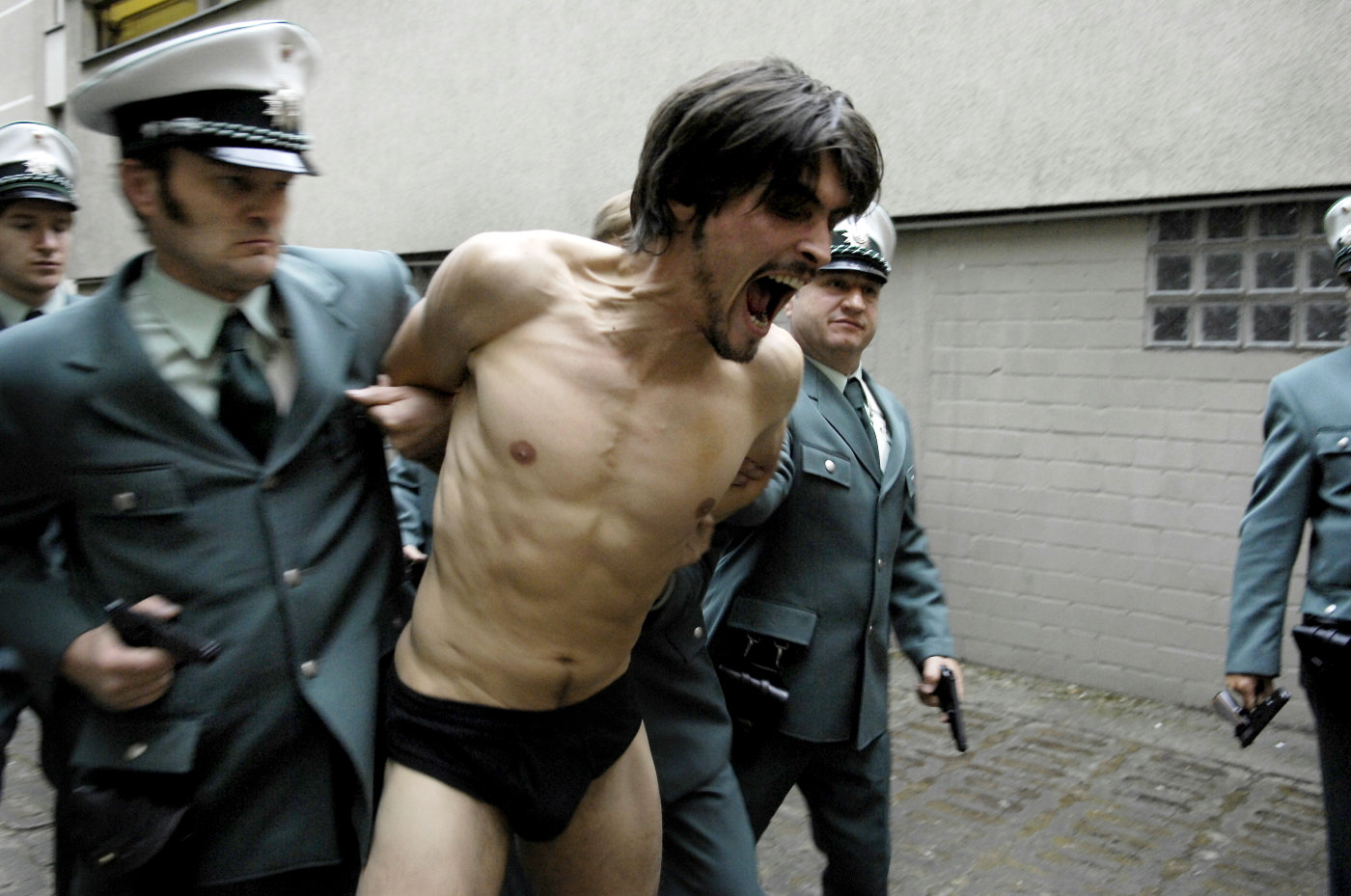
The film later focuses primarily on a radical faction of the disaffected youth — the Red Army Faction (RAF). This group grows increasingly violent as they find peaceful civil disobedience to be ineffective for immediate change. Their protests and minor crimes for attention soon escalate into organized bombings, robberies, kidnappings, and assassinations. This film lets you get in the shoes of the terrorists and show what was the impetus for this movement in the first place.

One of the arsonists, Gudrun Ensslin, was interviewed while in custody and she told the journalist: "This time we will put up resistance. We have a historical responsibility. People here and in America eat, eat, and shop, so they can never reflect or gain awareness, because otherwise they would have to do something. [...] I'll never resign myself to doing nothing. Never. If they shoot our people... then we are going to shoot back. [...] All over the world armed comrades are fighting. We must show our solidarity. [...] Such sacrifices have to be made. Or do you think that your theoretical masturbation will change anything?"

"What we need is a new morality. You have to draw a clear line between yourself and your enemies. Free yourself from the system and burn all bridges behind you."
-Gudrun
Trailer (in Deutsche because the English trailers don't do the movie any justice):
The movie starts off great with a string of interesting characters, great cinematography, and a gripping storyline. While the acting is superb by all the major actors and actresses, the film tends to drag a bit after the exposition. Also, the denouement also seems to be sloppy when compared to the rising action. The ending also seemed abrupt and unfinished; an epilogue might have helped with closure. Overall though, I thought the film was great and it stirred up great interest in me concerning the RAF, which I've never heard of before.
I also never knew about the disturbing fact that denazification was not complete in Germany in that many ex-Nazis assumed positions of power in Germany after the war. (source: Wikipedia — Red Army Faction).
Subscribe to:
Posts (Atom)